Measurement limits. User, bug-time and review-return figures are approximate historical reports from private operations, not publicly verifiable measurements. Their original counting rules are unavailable; the bug-time endpoints and review-return inclusion rules are not established, so these are not precise benchmarks.
No merged PR titled "Revert" among 249 PRs merged during 2026-09-11 through 2026-10-08 (UTC dates). The count from the private product repository's GitHub search includes all authors and dependency bots: with repository access, search with is:pr is:merged merged:2026-09-11..2026-10-08 via gh api search/issues and read total_count (249); adding in:title Revert returns 0. Only someone with repository access can rerun this count. Dates are inclusive UTC calendar days. This title search does not prove that no changes were reverted or that no regressions occurred.
Supporting activity context, not a success measure: 34–45 PRs merged per day during 2026-10-03 through 2026-10-06 (UTC days; the same all-author GitHub merged-date definition). These historical observations do not measure the effect of the newer workflow.
Independent review changes outcomes
Independent review caught a privacy problem in a chart-calculation-range fix before merge. In a separate October 2026 billing case, a browser agent's test-mode refund E2E showed that refunded reports continued generating; an author added regression coverage and fixed the behavior, a separate reviewer checked it, and the fix reached production. These are distinct examples of the process, not interchangeable evidence.
The billing case predates standing release authority. Its original Owner approvals are history, not today's deployment rule. Requested changes, author repairs and independent delta review—not rubber-stamp approvals—are part of the delivery loop.
1. Owner attention is the scarcest resource
The repository contract makes decision rights explicit. Architecture-level choices are delegated; my involvement is discretionary, not a mandatory gate.
| Decision | Authority |
|---|---|
| Technical design, root-cause scope, refactoring, slicing, test strategy and task order | Agent decides and reports why |
| Tooling recovery, Issues, branches, worktrees, PRs, docs and rule updates | Agent acts within scope, then records |
| Independently reviewed, verified code merge and criteria-based reconciliation | Standing task authority; original local-only, PR-only or review-only limits remain binding |
| Ordinary exact-main-commit production release | RELEASE releases only on defined release triggers, never per merge, under bounded standing approval, with readiness, full-gate evidence and postcheck; no per-commit prompt |
| Money, live payments, stores, external sends, production data/Ops actions, accounts, credentials and boundary-crossing releases | Explicit applicable Owner approval; code merge does not grant it |
| Product direction, pricing, legal/policy facts and scope expansion | Owner decides once; independent authorized work continues |
| Wording in all seven locales, including Korean | AI-managed independent exact-text-hash review; not an Owner copy-review gate |
2. The current native system
Five long-lived OMP root roles work one canonical GitHub queue. Role ownership is not proof that all sessions are currently running.
Delivery and release
- LEADER & DELIVERY: admission, coordination and cross-root integration conflicts; may integrate any authorized PR. Retires merged worktrees only after the lane's current writer performs owner-checked incremental cleanup and merged-PR identity and clean-state checks pass, never by age
- RELEASE: exact-commit readiness, ordinary releases within standing approval, and approved release/store evidence
Discovery and operations
- DISCOVERY: audits, evidence-backed Issues and authorized direct fixes with independent exact-diff review
- OPS & GROWTH: analytics, support preparation, content and campaign work, plus cross-root workflow and operations improvement (ops tooling and workflow/testing docs through independently reviewed PRs). LEADER keeps queue and procedure rule decisions; changes to a root's scripts need that root owner's review; only exact approved external effects
Migration and bounded slices
- BILLING MIGRATION: migration scope, handing support and release to their owning roots
- Bounded subagents, live host limits and measured memory/disk headroom, read fresh before each heavy start and sized per workload class, not a fixed global cap or worker count
- One writer per branch and generated surface; authors own checks, commits, push and PRs
Authoring roots may integrate their own independently reviewed PRs; LEADER may integrate any authorized PR and resolves cross-root conflicts. RELEASE may also integrate release-path PRs from any author and notifies LEADER.
Before sorting or admission, each candidate gets a compact evidence-backed product judgment in its existing Issue or PR: user harm and trust, core user value, the current journey bottleneck, affected scope with observed versus inferred evidence, and end-to-end completion cost and recurring value. The goal is observed useful user outcomes and recurring operational value, not PR or worker counts; a PR's age or sunk effort is not value.
Browser and peer messages. A browser teammate handles authorized test-mode E2E flows, locale/UX audits and read-only dashboards. Browser communication uses a file mailbox and notification relay. Coding sessions use direct addressed delivery between sessions, with recipient liveness checks and no browser relay. Messages use Request / Result / Next / Action required sections and carry no authority; pure FYI belongs on the owning Issue or PR, not in the mailbox. Durable decisions and evidence belong there too. The two transports are different mechanisms, not evidence of an identical end-to-end benchmark.
How it evolved — October 2026. Earlier work ran in the Codex CLI and Claude Code, then OMP and jcode; today OMP is the only coding host, routing OpenAI and Anthropic models by role. The timer-driven pool and privileged dispatcher were retired. Separate verifier replay and per-deploy approval are historical. The public kit is a historical/synthetic reference with reusable lease, guards, governance checks and navigation evaluation mechanisms—not the current workflow or a demonstrated OMP adapter. Synthetic tests do not establish live sandbox containment.
3. Gates that make speed safe
PASS + LLM_CRITIQUED. Sensitive copy also needs domain review; pricing, legal and policy facts retain their owners.4. Context tools are leads, not evidence
Confirm callers and impact in source, rather than trusting an index.
5. Same principles, client context
On an existing client codebase, bounded authoring and independent review turned a manual workflow into working server-backed, role-based interfaces.
6. Upstream fixes found by dogfooding
Running many concurrent agent sessions on one machine stresses the harness itself. Harness defects get the same treatment as product defects: reproduce, isolate, fix with a regression, send upstream.
read line < <(cmd) could hang because the read blocked the runtime worker before the producer ran; the same hang stalled a live agent shell command on 2026-10-14. The maintainer's #15509 landed the read deadlock fix and its single-worker regression, graciously crediting my original patch. My #15504 was narrowed in review to a regular-file fast path and merged. The mapfile/readarray fix #15647 remains open, with a single-worker regression that timed out before the fix and passes after it..env (#15476) and per-worktree build-cache clones exhausting disk (#15475). In jcode, contiguous TUI typing became one undo step (#1714) and CI formatting was restored (#1739).Status as of 2026-10-15: oh-my-pi #15504 and #15509 merged and #15501 closed; #15647 open in maintainer review; #15478 open with no maintainer review yet; jcode #1714 and #1739 merged. Each pull request records the reproduction, the scenario exercised and the checks run.
Historical visual evidence
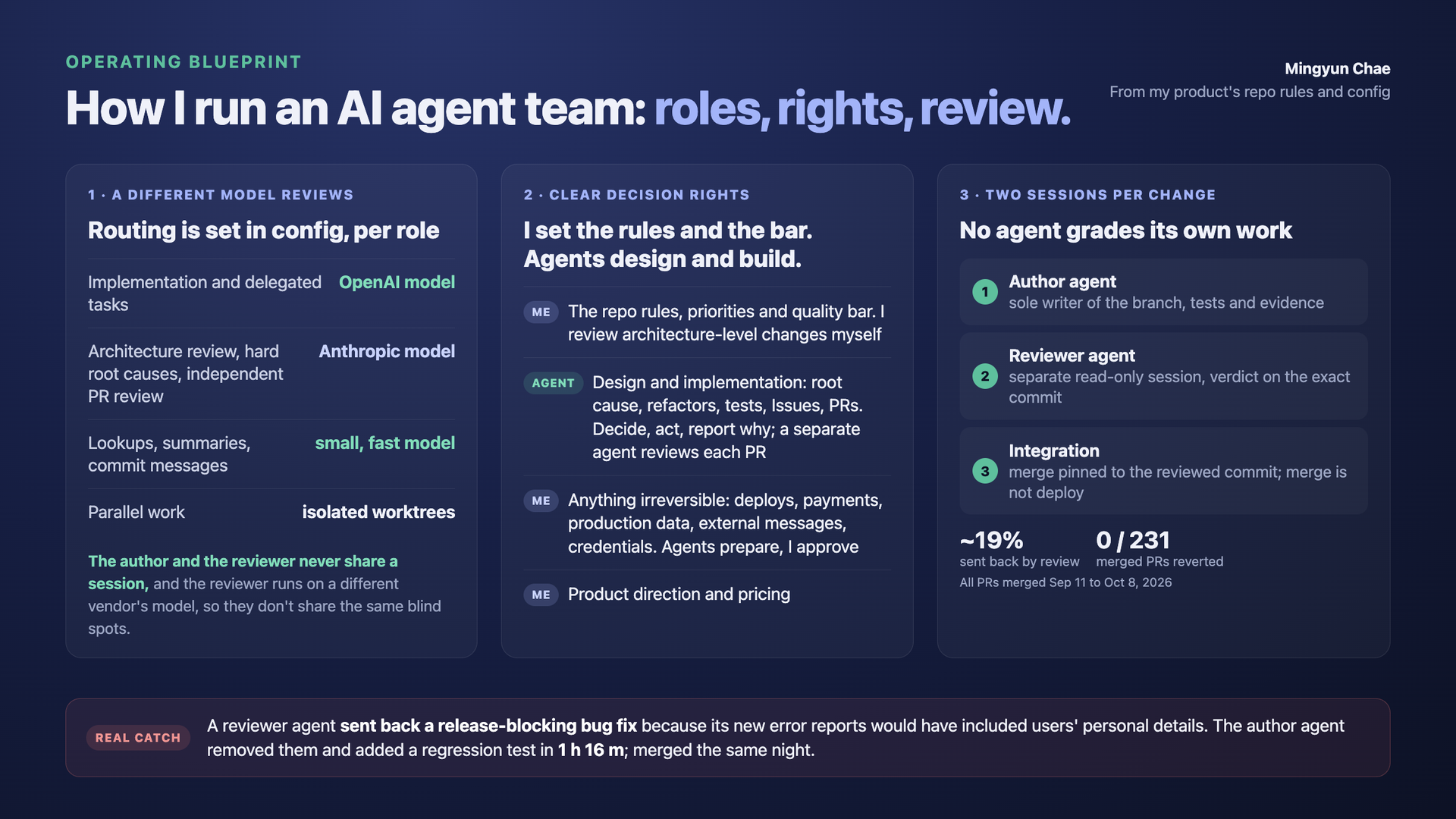
This historical blueprint contains obsolete approval rules. The current text, not the image, describes today's operating contract.
Publication hygiene
Before publishing, stage the intended files and run bash scripts/check-publication.sh origin/main (Git and Python 3 only). The pinned pull-request workflow checks staged text, incoming commit trees and messages, and requires GitHub noreply author and committer identities. It rejects non-noreply email addresses and common credential patterns in text. This limited guard does not inspect binary media, detect every secret or remove existing history; public text and images still require human review. Existing history is intentionally unchanged.